



 By Don A. Wright
The California State Board of Food & Agriculture met in Sacramento and online Tuesday, March 3, 2026. The Board’s purpose is described on its website as, “The California State Board of Food and Agriculture serves the interest of the state’s diverse agricultural community. As an advisory board to the governor and secretary, the board addresses key issues that are of importance to California’s farmers and ranchers, community stakeholders, and citizens.”
California Secretary of Agriculture Karen Ross was at this meeting. Fresno County farmer Don Cameron is the Chairman and Dr. Rolston St. Hilaire, Dean of Agriculture at Fresno State University sits on the board.
The Meeting
The meeting began with Department of Water Resources Director Karla Nemeth giving an update on the water situation in the state. She spoke at length about the improvements available in the area of predictions and how this can help with FIRO, Forecast Informed Reservoir Operations. This of course brought to mind the outstanding work Weather Tools has been delivering. That’s not a shameless plug for a client. Checkout where long range forecasting can go.
SGMA Panel
A panel dealing with the Sustainable Groundwater Management Act included testimony from Tomo Kumahira, WaterOne.ai, Aaron Fukuda, General Manager Tulare Irrigation District and Dr. David Ceppos from the Demand Management Network.
Ceppos spoke first saying under SGMA there will very likely be the need to enforce demand management. Now, demand management is essentially reducing pumping to bring the aquifer into balance. It’s not popular with growers or anyone else in the ag economy. More surface supplies are the best way to recharge our way back into balance. But this isn’t a sane world and while it might be as welcomed as a band aid floating by in a public pool it’s good somebody is looking at how to best incorporate pumping reduction as sanely as possible.
Kumahira spoke next explaining how WaterOne.ai has been following trends and what conclusions can be drawn.
Fukuda said SGMA is not about pumping groundwater, it’s about pumping surface water being stored in the ground. You can’t pump out what you don’t put in. Tulare ID leaned into the 2023 wet year and had the highest recorded diversion rate in its history. The TID growers are the reason, they are taking water onto the land with flood irrigation. There were zero flood claims and the highest recharge rate in the district’s history. As Fukuda pointed out, how things change. Flood irrigation used to be frowned upon by certain people who believe they understand water. Although it was flood irrigation that recharged the aquifer they pushed and scolded to increase irrigation efficiency. The highly efficient irrigation resulted in more acreage planted but not recharge. Then the regulators reduced the amount of surface water forcing more pumping. And surprise – overdraft.
Cameron asked Fukuda were the crop patterns changing in TID? Fukuda said there is some small shift, such acreage returning to olives and there is more acreage going to cotton, but in total no more than five percent. There is fallowing and a distressing land value drop. He said the value of the land in the agricultural sphere has halved or more from SGMA. SGMA is driving landownership to the banks and the counties. There are no buyers for the white area lands. The only land selling is districted lands.
St. Hilaire observed how using Land IQ has been a good move. He asked how that technology is going. Fukuda said there is now a real time evapotranspiration calculation and that is helping the growers.
A question was raised about groundwater quality. Fukuda said there is now a groundwater quality network in place and the water quality appears to be trending upward. As nitrate groundwater is pumped and used it is being replace with Sierra Nevada snowmelt.
Fukuda was also asked about subsidence. He said the data gap has been an obstacle but subsidence is taking place. However, the recharge is helping decrease subsidence but it is reduced pumping that is giving the best bang for the buck. Cameron asked about new wells and Fukuda said there are very few wells going into the lower aquifer. Almost all new wells are upper aquifer.
Fukuda was asked what irrigation districts need. He said there has been a tremendous investment in SCADA and in-canal infrastructure. Growers are having to invest in better filtration for their irrigation systems to deal with any sediment loads or algae considerations.
Water Management Issues
Dr. Eddie Ocampo, Chair San Joaquin Valley Water Blueprint, Martha Volkoff CF&W and Fritz Durst representing Reclamation District 108 on the Sites Reservoir JPA spoke next.
Durst said the Sites Reservoir plans have been floating around for many decades. In the 1990s an MOU was signed by local districts with several principals that included user pays, environmental support and a flexible schedule. There are now 22 agencies with 13 more on a waiting list. An EIR and EIS was circulated on the projects. This is an important point as those documents had been given to the Sites group from DWR. This set of plans has since been updated to be much more environmentally friendly. So, when you hear objections to Sites find out which set of plans are being addressed.
Flows coming down the Sacramento River from the ephemeral streams are the main source of Sites inflow, it doesn’t come directly from Lake Shasta. The water will be taken at specific times to avoid salmon migrations and he hopes to see a groundbreaking in 2027. The Sites JPA is going through all the legal hopes it can to present as bullet proof a plan as possible to limit the litigation. One of the big benefits is adding more flexibility to Shasta. Water can be released from Shasta to help with temperature control and this has excited the US Bureau of Reclamation’s cooperation.
Volkoff spoke next and gave a golden mussel update. She said these bivalves (Limnoperna fortunei) are natives of China and first found in the Port of Stockton in October 2024. It is also found in Southeast Asia and South America. The golden mussel, the quagga mussel and zebra mussels are all invasive species. While all three can live in fresh to brackish water only the golden mussel can live in low calcium water. The water coming off the Sierra Nevada is low calcium and that is troubling.
Volkoff said CDFA performed a pest rating and gave the golden mussel an A, finding they are detrimental to either the environment, to agriculture or there is a chance people could be harmed. It is listed as an invasive mussel. The US Fish and Wildlife Service is proposing to list it as injurious species list.
The golden mussel will travel and encrust infrastructure. They live two to four years and are highly reproductive. They can float and drift through the water, attach to a boat and get transported to other bodies of water. The current strategy is to prevent further spread. Containment and population suppression are part of this.
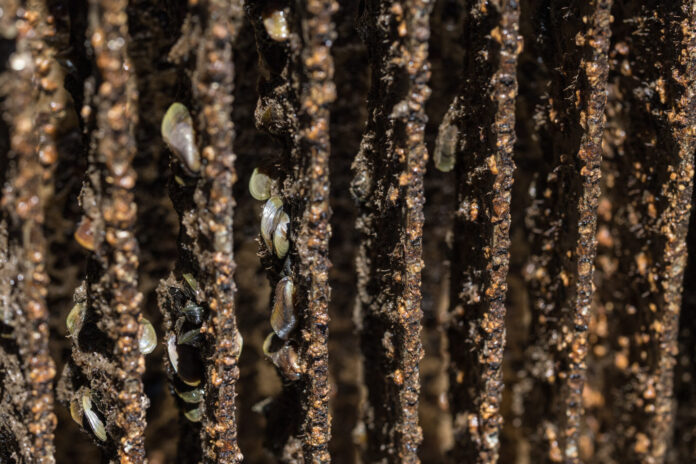
So far the golden mussel ranges from the Delta to as far south as Riverside through the California Aqueduct. Volkoff showed photos of what happens when the little boogers bio foul infrastructure. They gang up and cover fish screens, pumps and you name it. One photo showed how an incredibly dense mass of mussel have clogged irrigation pipes in the Delta.
Veliger, the name of mollusk larvae, have been identified in and shown to survive in entrapped water. A bunch of them lasted four months in a jar a water on a desk.
What is lethal to the pest? Salinity maybe? Did they survive a transoceanic voyage? I don’t believe anyone is quite sure how they got here. Copper and Zequanox toxicity are being used as treatment, with ultraviolet light and filters as well. Volkoff is looking at more boater inspections and keeping a close eye on making sure the golden mussel doesn’t spread.
Ocampo spoke next saying the thread running through today’s event has been better communication. Ocampo works with Self Help Enterprises helping with domestic water wells. It became very evident SGMA will impact some of the most vulnerable communities in the San Joaquin Valley. The Blueprint recognizes more than one million acres of farmland has already been lost in California. Changing weather patterns, increased regulatory constraints and competition for water resources are placing a strain on the Valley. Another million acres of farmland are on the verge of being lost to SGMA.
The Blueprint was formed to increase communication and is a coalition of the willing. The San Joaquin Valley needs a voice and the Blueprint provides this voice. SB 72, is building towards an additional nine-million-acre feet and the Blueprint is on board with this. The Blueprint also supports the federal Action 5 to bring about much better long term water management. This includes maximizing the potential of the Healthy Rivers and Landscapes (Voluntary Agreements) to bring more surface supplies to the San Joaquin Valley. Without action the SJV’s culture, economy and people are in peril. And that’s no joke.
The meeting then adjourned for lunch and so did I. Go be good to each other and yourselves.
DISCLAIMER OF RESPONSIBILITY; Waterwrights.net strives to provide its clients with the most complete, up-to-date, and accurate information available. Nevertheless, Waterwrights.net does not serve as a guarantor of the accuracy or completeness of the information provided, and specifically disclaims any and all responsibility for information that is not accurate, up-to-date, or complete. Waterwrights.net’s clients therefore rely on the accuracy, completeness and timeliness of information from Waterwrights.net entirely at their own risk. The opinions expressed in this report are those of the author and do not represent any advertisers or third parties.
ALL RIGHTS RESERVED. Copyright 2026 by WaterWrights.net