




 By Don A. Wright
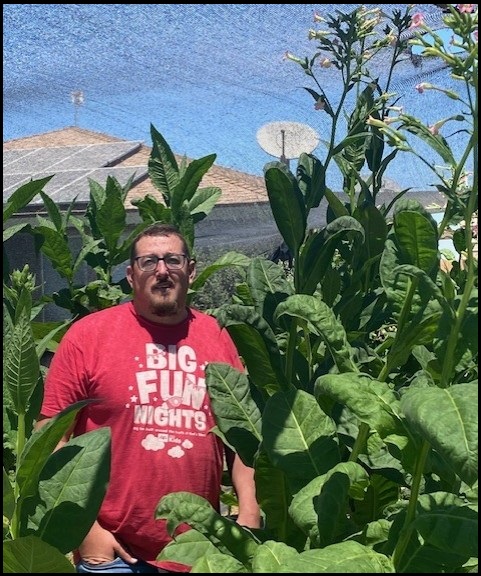
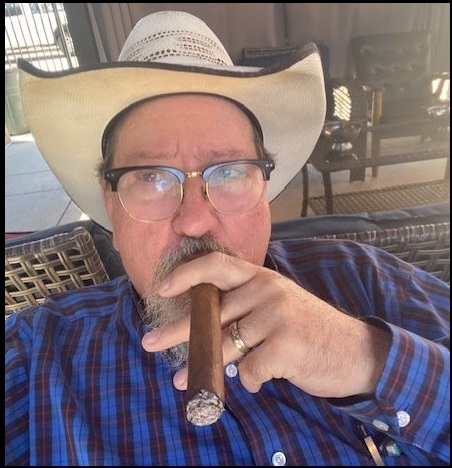
California’s San Joaquin Valley is a world powerhouse of agriculture. It’s also facing a combination of factors coming together to reduce its water supplies. One solution for growers is changing the crops grown. Timothy Greene may have the answer. Greene grows tobacco and hand rolls his own brand of cigars. T.W.G. Cigars located in Fresno County may hold the key for some farmers looking to change to a less water intensive crop.
“I see T.W.G. as more than just a cigar company. The long-term goal is to build a vertically integrated business around premium cigars—from growing the tobacco here in the San Joaquin Valley, to curing and fermenting it, to blending and hand rolling the finished cigar,” said Greene. “I’m not interested in competing by becoming the biggest cigar company. I want to build a company known for quality, craftsmanship and for doing something that is uniquely connected to this region.”
Greene doesn’t come from an agricultural background. He graduated from Fresno State University with a degree in kinesiology and worked as a physical therapist when the idea of doing something different took hold. He likes cigars and he likes the culture that comes with cigars.
Can tobacco grow commercially in California?
Chris Alexander is Assistant General Manager of Cigar LTD in Clovis and Fresno, California, “T.W.G. cigars are featured in our shop. They are premium and fit in well with our cigar culture. I believe there is plenty of room in the industry for San Joaquin Valley tobacco as a regional source.”
The Valley is facing a potential catastrophe from over regulation and government mandated water supply reductions. A study by the Water Blueprint for the San Joaquin Valley estimates the impacts of the Sustainable Groundwater Management Act (SGMA) and other stressors could soon cause a permanent fallowing of more than 750,000 acres. Some estimates go as high as 1.5 million acres or between one/fifth and a quarter of the nation’s most productive farmland could be idled due to a lack of water supplies being made available.
This lack of water is hitting small farmers particularly hard, especially those with permanent trees or vines that need water year-round. If a farmer grows annual row crops he can plant according to water supply. However, the investment in orchards and vineyards is much greater and takes place over the course of years; wet or dry. One cannot not water a tree or vine and stay in business.
Changing Crops
One of five Mediterranean climates on earth, the San Joaquin Valley grows more than 300 crops worth $30 billion in annual farm gate value. (Farm gate is the value of the almond on the tree, the milk in the udder and grapes on the vine before processing into ice cream or wine.) The state grows nearly half of the country’s vegetables and over three-quarters of the country’s fruits and nuts – most of that comes from the San Joaquin Valley. There are other efforts underway to introduce new, lower water usage crops to the Valley like agave for developing a tequila-like spirit.
Almonds and other nut and fruit trees will take three to five years to yield a mature harvest. They also use on average about three-acre feet of water per acre per year.
Tobacco has the benefit of being an annual crop, meaning it’s planted anew each year in late March through early April. Tobacco grows about seven feet tall with 18-26 leaves per plant and yields three harvests per growing cycle. Greene says the good news is an acre of tobacco, about 6,000 plants require only one and a third acre feet per season. Less than half of the water needed to support permanent orchards.
San Joaquin Tobacco?
Although estimates for the cigar market vary there is a consensus the premium cigars’ popularity is growing. The Center for Dease Control estimates Americans smoke 13 billion cigars annually. The 2026 market size is more than $14 billion and expected to surpass $22 billion annually by 2033.
Mention cigar tobacco and one most often thinks of the Caribbean and Central America with Cuban grown and manufactured at the pinnacle. However, tobacco is grown in many states including the Carolinas, Kentucky, Virginia and the un-tropical Connecticut. Still these areas have higher summer humidity and more cloud cover than the sunny and dry San Joaquin Valley. Greene believes he’s found a way to duplicate the ideal growing conditions for tobacco here in the Valley.
Greene says yes, “Tobacco loves our summer heat. You have to keep a close eye on the irrigation schedule and it requires some shade to emulate the cloudier conditions of the tropics but you can grow a high-quality plant here in the Valley.”
Most tobacco cultivation and cigar manufacturing come from generational businesses started by families. How did Greene learn to grow tobacco and make cigars?
“Thousands of hours of You Tube and I’m voracious reader when it comes to subjects I’m interested in,” said Greene. “I’m a little compulsive, a little obsessive. A friend of mine asked me to help put on a cigar event for some railroad employees. They wanted custom made, special blend cigars. I hand rolled 750 cigars and they all sold out.”
Filler Binder Wrapper
There are three parts to a good cigar, each using different types of tobacco and each lending flavor characteristics. The filler tobacco is the center part of the cigar. Long filler is considered the only type to use for a premium cigar. This means the tobacco used for filler is cut longer; it’s not bits and pieces of left over leaves such as are used for cheaper cigars.
Binder is the second type of tobacco and wraps around the filler to keep the shape. It too adds flavor and aroma to the cigar.
Wrapper is the final type of tobacco leaf used. It is thinner and comes in various shades depending in part on how it’s cured. Maduro is the dark brown/chocolate colored wrapper. Other wrappers include the Connecticut, Corojo and Habano. A single tobacco plant can grow all three types of leaf at different levels on the plant.
Because a cigar’s quality includes aesthetics the wrapper must be as free of blemish as possible. It has to be thin and have minimal veins with a uniform color. Wrapper tobacco is also the most expensive grade of leaf selling for around $60 per pound. Greene estimates about half his crop goes to wrapper.
Curing Tobacco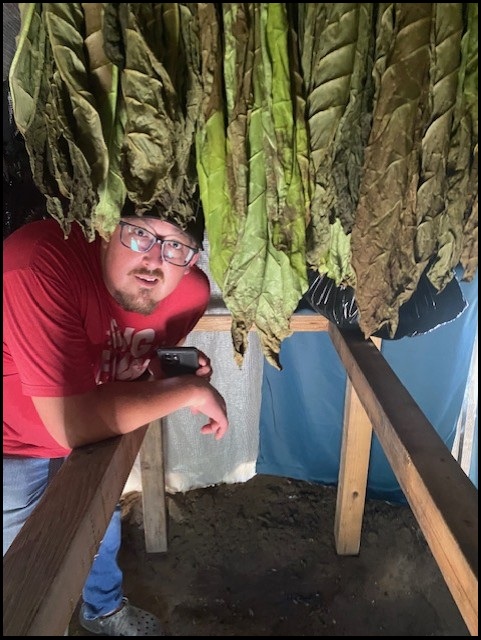
After harvesting the tobacco leaf it must be cured properly. Greene has developed a process that duplicates the more humid conditions of other parts of the world where tobacco is traditionally grown and cured. He uses a tarp enclosure, monitors the humidity and temperature. He adds water as needed. Simple as that.
The different leaf types are sown together on a string and hung in this controlled environment. The curing process removes ammonia and other harsh constituents from the plant and creates fermenting which removes some of the moisture and chlorophyl while bringing forth the flavorful oils. Greene’s quality control calls for at least a 45-day cure time. Although, some very expensive cigars are made from tobacco that’s been curing for five years.
Rolling a Cigar
Greene estimates he’s rolled thousands of cigars since starting T.W.G. Cigars come in a variety of standard sizes. There is the ring size – diameter measured in 64th of an inch and the length measured in inches. A 60/6 is a cigar 15/16ths of an inch around and six inches long. The size also gives an idea of how long the smoking experience will last. Bigger cigars last longer and have a different flavor profile than smaller cigars.
There are also cigar shapes. Parejos are the most widely produced, they are a cylinder with one end open and one end domed that you have to cut. They range from small ring and short length to large ring with long length to every combination thereof. Figurados are cigars that deviate from the cylinder shape such as pyramids, torpedoes, perfectos and Salomons. They are usually more tapered at one end or both.
Greene set up T.W.G.’s production facility in warehouse space in downtown Fresno. He’s having to increase his square footage as this coming year T.W.G. will be expanding to one acre of its own tobacco, also grown in Fresno County. Greene teaches others how to roll.
“The biggest challenge as we increase our tobacco production will be making sure our cigar production grows with it,” said Greene. “Right now I personally roll the majority of our cigars, but I don’t intend for the entire future of T.W.G. to depend on one person sitting at a rolling table. I’ve already started teaching other people how to roll, and that will become an increasingly important part of the business.”
Building A Cigar Community
It’s one thing to have a vision and another to build it into reality. Part of Greene’s journey is learning how to scale the company’s growth to achieve his goals. T.W.G. has secured a one-acre test plot for spring 2027 planting.
“We’re starting with one acre of our own tobacco, and I want to prove the model before trying to scale it too quickly,” said Greene. “Over the next five years, my goal is to grow T.W.G. to approximately 100 acres of tobacco production. That would give us the opportunity to produce a significant supply of our own tobacco while creating the infrastructure and workforce necessary to turn that agricultural production into finished, premium cigars. If the agricultural side performs the way I believe it can, we can continue expanding from there.”
Green’s plan for T.W.G. is to develop a consistent rolling process and train skilled rollers who can produce cigars to the same specifications and high quality standards as befitting a premium cigar. Like any growing business Greene has to wear many hats.
“Getting the rolling and production process developed allows me to gradually spend more time in the areas where I add the most value—developing blends, overseeing the tobacco from curing through fermentation, quality control, teaching and training, and continuing to develop the T.W.G. brand,” said Greene.
With water supply one of the Valley’s most pressing needs tobacco may well become an economically viable crop for farmers, particularly for the smaller growers with only the increasingly regulated groundwater to rely upon.
“The exciting part for me is that the tobacco itself becomes part of the story,” said Green. “Instead of simply buying tobacco from somewhere else and making cigars in Fresno, I want people to eventually be able to smoke a T.W.G. cigar and know that the tobacco was grown, cured, fermented and rolled right here in the San Joaquin Valley. That’s the vision.”
DISCLAIMER OF RESPONSIBILITY; Waterwrights.net strives to provide its clients with the most complete, up-to-date, and accurate information available. Nevertheless, Waterwrights.net does not serve as a guarantor of the accuracy or completeness of the information provided, and specifically disclaims any and all responsibility for information that is not accurate, up-to-date, or complete. Waterwrights.net’s clients therefore rely on the accuracy, completeness and timeliness of information from Waterwrights.net entirely at their own risk. The opinions expressed in this report are those of the author and do not represent any advertisers or third parties.
ALL RIGHTS RESERVED. Copyright 2026 by WaterWrights.net