

 By Joel Hastings
The Madera Irrigation District held a luncheon for growers and friends on October 20, 2026 at the San Joaquin Winery owned by the Schafer family, themselves growers and MID members. A nice crowd of 80-plus folks turned out to hear about significant accomplishments achieved by the district in recent years and afterward enjoyed a buffet lunch.
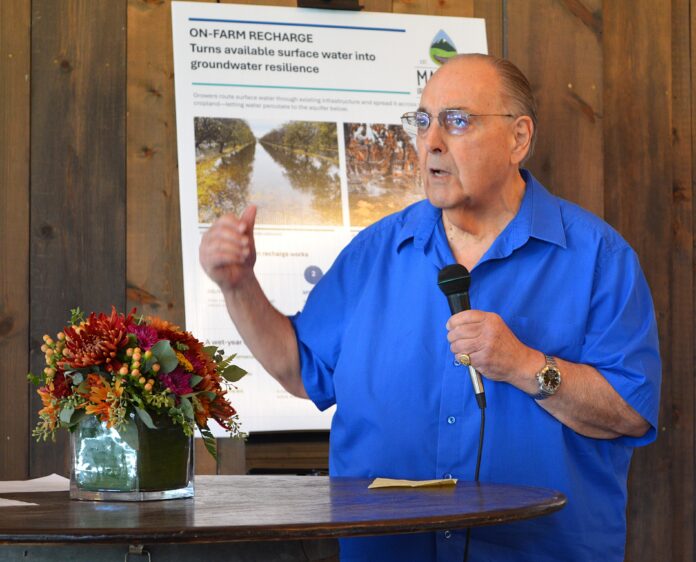
Board President Dave Loquaci welcomed the audience about 11:30 a.m., explaining that the session was technically a board meeting, so he led off with the flag salute. He introduced his fellow board members and then turned the microphone over to General Manager Tom Greci who said this kind of session had been held years ago but not during his 15 years with the district. He referred to the six posters on display documenting achievements which he spoke about. But first, he introduced the staff there, thanking Assistant GM Dina Nolan, Operations & Maintenance Manager Charles Contreras, Operations Assistant Manuel Guillen, Controller Jennifer Furstenburg and office workers Carmina Espinosa and Alejandra Santillan. He also thanked General Counsel John Kinsey for his attendance.
Three organizations that work with MID had displays here and Greci introduced the staff who each spoke briefly about their services for growers. Leading off for PG&E were Marie Ballesteros and Alejandro Calviut of the small business and ag teams. They said the utility can recommend rate plans and audit the efficiency of pumps and equipment to secure the most favorable rates. Kevin Reyes, manager of the Madera Chowchilla Resource Conservation District, the non-profit, non-regulatory agency which provides technical assistance to growers for a variety of property improvements for water conservation and regenerative agriculture. Finally, Sean Neal and Princesa Ceballos Madirgal spoke on behalf of USDA’s Natural Resources Conservation Service, briefly describing a groundwater recharge pilot program and the EQUIP machinery replacement program along with other assistance for improving soil and air quality.
Returning to the microphone, Greci said there is funding available specifically for MID growers from these groups. He continued explaining the first area of accomplishment he wanted to describe was the extensive renovation of the district’s 150 miles of pipelines and water conveyance infrastructure. He said an audit had been carried out in 2019 to establish a priority for replacement and a million dollar grant from NRCS along with the district’s own funds were being invested to install new pipelines, SCADA gates and a new alarm system detecting leaks and alerting staff mobile phones.
He next said that five major recharge basins had been completed with land purchases, tree removal and excavation all done in house. He said the most recent is a 60-acre basin in Fairmead, a disadvantaged community badly in need of groundwater support. He said there is a continuing partnership with the city of Madera to expand the basin water storage at the municipal golf course, creating effective water hazards for the golfers but also providing expanded recharge opportunities. He said in all, the district has more than 1000 acres of recharge basins allowing acceptance of short notice water supplies from Friant as well as flood waters in wet years.
He continued, saying that everyone is asking about El Nino. “Here is where I ask for your help,” he said addressing the growers. He said on-farm recharge using your pumps and flooding your trees and vines can make a big contribution to stabilizing groundwater levels. He said while the water is not quite free, the cost to growers for district water for recharge is only $10/AF, which allows water to be distributed efficiently. He said NRCS can help with funding for on-farm recharge basins, as well.
The next important development he reported was the sale of the Madera Ranch property, 11,000 acres on the west side of the district, rangeland that had been owned since 2005. It had been originally intended as a water bank that never materialized. He said the sale to a land preservation agency would allow the property to be kept free of development and eventually available for public recreation and habitat protection, while contributing to the district’s water balance. Very importantly, the sale allowed the payoff of the $2.5 million bond 12 years early providing huge cash flow savings. This, combined with the early payoff of a 2015 bond in September makes the district 100 percent debt free – a statement that drew a round of applause. The elimination of the 2015 bond allowed a district tax to be reduced from $39 / acre to zero on the 2027 property tax bill.
Along way Greci said the district has been able to develop financial reserves that in the future will contribute virtually millions in dividends. All this contributes to lower costs which can be passed along to growers. He invited luncheon guests to look at the detailed posters displayed and talk with staff about any questions.
This concluded his presentation and President Loquaci once again thanked growers for attending. He urged them to spread the word to their neighbors about what’s going on at MID. He said growers have participated by using every drop of water the district can obtain and their help will be needed if there is another wet year like 2023. He said he hopes the district will be able to bring in and use as much as 450,000 AF in this coming year.
He said the work that had been described has taken years to accomplish and it’s been done primarily with the staff in place… “we haven’t blown our money with consultants or bringing in extra staff.” He said we have upgraded the district’s equipment so the staff can accomplish the work. He also acknowledged Counsel Kinsey for his help negotiating many situations.
Finally, he said your land in MID has managed to keep its value because you are in an irrigation district that is financially sound and has water. He asserted, “You are in one of the best districts up and down the state.”
“Tell your neighbors to be ready for El Nino if we get a wet year,” he concluded. He said all this water Is going into the ground to support the aquifer.
He thanked the Liberty FFA for the colorful floral table centerpieces and then, right at noon invited everyone to enjoy the lunch… which they seemed to, both because the tri-tip, chicken and fixings were delicious but also because they had just heard quite a bit of good news.
DISCLAIMER OF RESPONSIBILITY; Waterwrights strives to provide clients with the most complete, up-to-date, and accurate information available. Nevertheless, Waterwrights does not serve as a guarantor of the accuracy or completeness of the information provided, and specifically disclaims any and all responsibility for information that is not accurate, up-to-date, or complete. Waterwrights’ clients therefore rely on the accuracy, completeness and timeliness of information from Waterwrights entirely at their own risk. The opinions expressed in this report are those of the author and do not represent any advertisers or third parties.
ALL RIGHTS RESERVED. Copyright 2026 by WaterWrights.net
Madera Irrigation District – 12152 Road 28 ¼ Madera, CA 93637 559/673-3514
Staff: General Manager -Thomas Greci, Assistant GM – Dina Nolan
Board: Dave Loquaci, president; Brian Davis, vice-president, Brandon Bishel, Tim DaSilva and Carl Janzen
HISTORY: From www.madera-id.org The Madera Irrigation District (MID or District), founded in 1920, encompasses an area of approximately 139,665 acres. MID operates a primarily gravity irrigation distribution system with approximately 300 miles of open flow canal systems as well as 150 miles of large diameter pipelines.
The District has a Central Valley Project (CVP) repayment contract with United States Bureau of Reclamation (USBR) providing up to 85,000 acre feet (AF) of Class 1 and 186,000 AF of Class 2 water per year from the Friant Division (Millerton Lake). The CVP water is released from Millerton Lake through the Friant Dam, and then conveyed through the Madera Canal for delivery into the District’s service area. The District also entered into a CVP repayment contract with the USBR for the yield from the Hidden Unit (Hensley Lake). Under the Hidden Unit contract, the average annual supply available to the District is approximately 24,000 AF per year.
DWR SGMA # 5-022.06