




 By Joel Hastings, all photos J. Hastings WaterWrights.net
The California Water Institute at Fresno State organized and conducted a two-day conference aimed at not only providing new information but also setting priorities for action to address the water crisis in the San Joaquin Valley. Over 150 people attended all or parts of the two-day session on May 20-21 on campus representing an array of water industry participants including growers, community leaders, water managers, academics and government officials.
The group heard reports of new studies from the Department of Water Resources (DWR), an update on the recently completed “Unified Water Plan for the San Joaquin Valley” from the Water Blueprint and the State’s Water Plan for 2028. Panel discussions provided additional background on this detail during the first day. Then on the second day, the whole group engaged in an in-depth effort to identify actions needed to accomplish specific priorities for results.
The mission, and the need, is to create nine million acre-feet of additional water for the Valley by 2040. This is now DWR’s priority as it implements the legislature’s SB 72 passed unanimously last year.
Thursday, May 21 – Day Two Priorities for Action
To open the session, Laura Ramos, conference organizer and director of the California Water Institute, introduced Dr. Xuanning Fu, Fresno State Provost. He said today we shift from understanding to action. He continued, saying that when we all work together to eliminate silos, we will see results. As humans, he said, we should do better than the dinosaurs and protect our ecosystem with water. Among the challenges he said are regulatory adjustment. He asked, how can we include groups that have less power but need water the same way we do. Water issues are people issues, he asserted. Water is life and we can no longer take it for granted. He concluded, “We look forward to your success.”
Ms. Ramos explained that yesterday was understanding, but today is commitment. At the end of the day, she asked, what are the regional priorities, pilot projects to demonstrate and what policy to adopt. She said CWI will play a role with education in its DNA and research to help connect people. We don’t need perfect agreement, she said, but rather practical alignment. Yesterday we saw the system, she said. “Today, let’s decide how to move it,” she concluded.
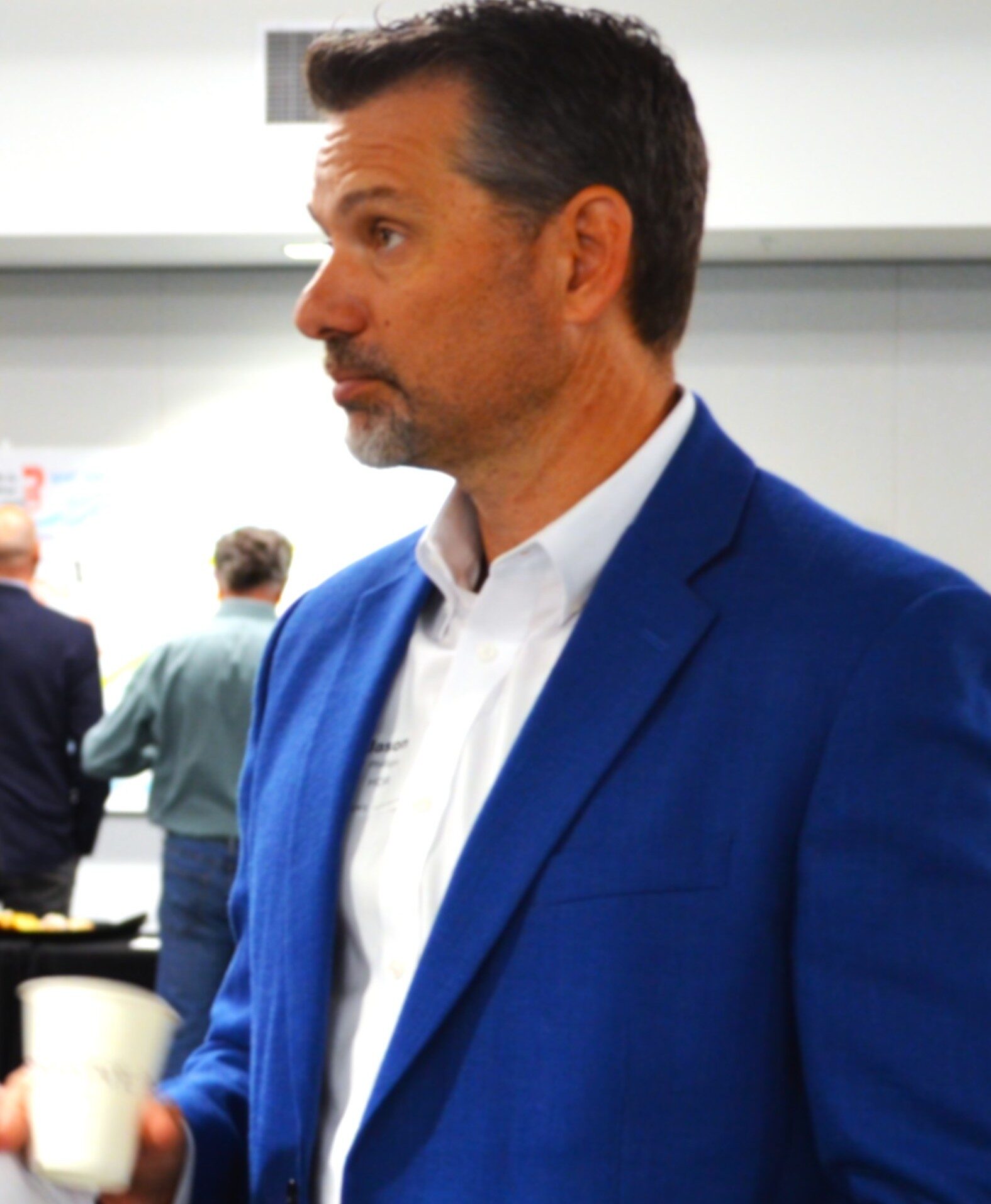
She introduced the morning’s first speaker, Jason Phillips, most recently CEO of the Friant Water Authority and now working with the engineering consulting firm HDR based in Phoenix, Ariz. He said the words he had heard so far were “candid” and “practical.” He called himself a 28-year survivor of California water. He said the trajectory we have been on, whether you like species, ag, urban, whatever, the last 40 years are not what we need for the next 40.
He challenged the audience saying if you have any influence to speak to someone as if you speak for the Valley, he said, “Please know what you are talking about.” We’ve tripped ourselves,” he said, “by asking for things that are selfish.” He said an example is a “small ask” for some project that yields 20,000 acre-feet a year which is nothing when you look at the total deficit. He said it’s great to capture flood water, but local control is not our issue. “Local control is code for ‘You’re screwed!’ ” he declared.
We have a system that is reliant on imports, he continued. The math doesn’t add up when you have only local supply. In the Valley we’ll tell a third of our farmers to leave and then we can balance our supply. He said SB72 makes DWR use real numbers and we’re nine-million-acre feet short by 2040.
He said, “I’m very passionate that when we have an opportunity like this [Summit], I don’t want us to screw it up. What should we ask for? The feel-good stuff is only going to be the demise of the Valley. It’s the hard stuff we should start tackling. We need to figure out how to ask the governor to help us. We’re bult on a system that requires the state and federal governments to bring water into the Valley.”
He went on to declare his support for the Blueprint. He said we are two to four million acre-feet short per year – in a dry year as much even more of overdraft which is why the ground sinks.
He said we passed Prop 1 with the wrong people negotiating. We traded SGMA for Prop 1 and it was the legislature telling the Valley, “You’re toast and Prop 1 is your help… but it’s only environmental water. Who speaks for the Valley and who’s accountable here?”
He said we have to ask for the big things but we do have to ask for the small things too, like GSA projects. He referred to DWR’s Joel Metzger who said a day ago that the state wants to know what we really need but we have to ask with a unified voice.
But what does the state do? By following a 40-year-old regulation, 100,000 cubic feet per second goes into the ocean but at the same time they reduce pumping in the Delta! Who can raise the red flag on this, he asked. A couple of days later the state came out with a temporary solution. The old environmental rule isn’t working. It changes for five days and a million acre-feet of water is available.
He concluded asserting, “I believe in asking the state to support the Blueprint… fund local projects but support the Blueprint. You need to identify and prioritize how you are going to get a new supply of three million acre-feet per year. Land retirement will be the default but it’s the most expensive option. We have an opportunity and that’s where we can be optimistic.”
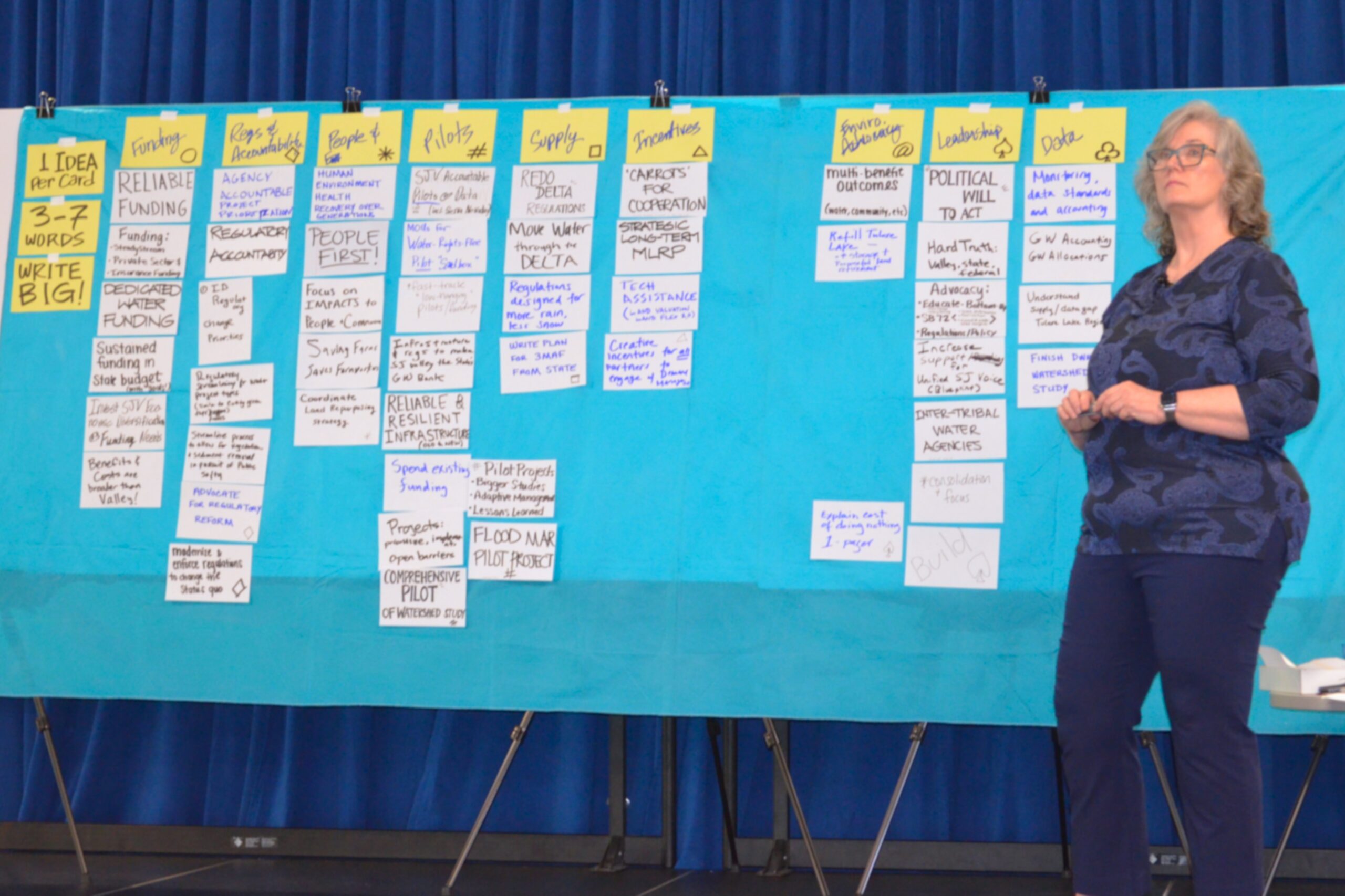
Following this no-holds-barred presentation, the group shifted gears to get involved establishing priorities. With direction from a professional facilitator, Raven Tahara, a consultant from Sacramento, the group began by assessing the key words and phrases on the posters from yesterday’s meeting. Over the next several hours, attendees identified priority topics in eight categories as follows:
- Test Multi-Benefit Solutions
- Tell Our Story
- Restructure Regulations for Effectiveness
- Protect People and the Environment
- Create Sustainable Funding
- Gather Date to Inform Decisions
- Develop Effective Incentives
- Allocate Sustainable Supply
Attendees divided themselves into groups according to their interests and developed two to four steps for implementation of each action category. These separate groups then reported back to all the attendees who had reconvened. All this information as captured by the CWI staff and will be compiled for distribution.
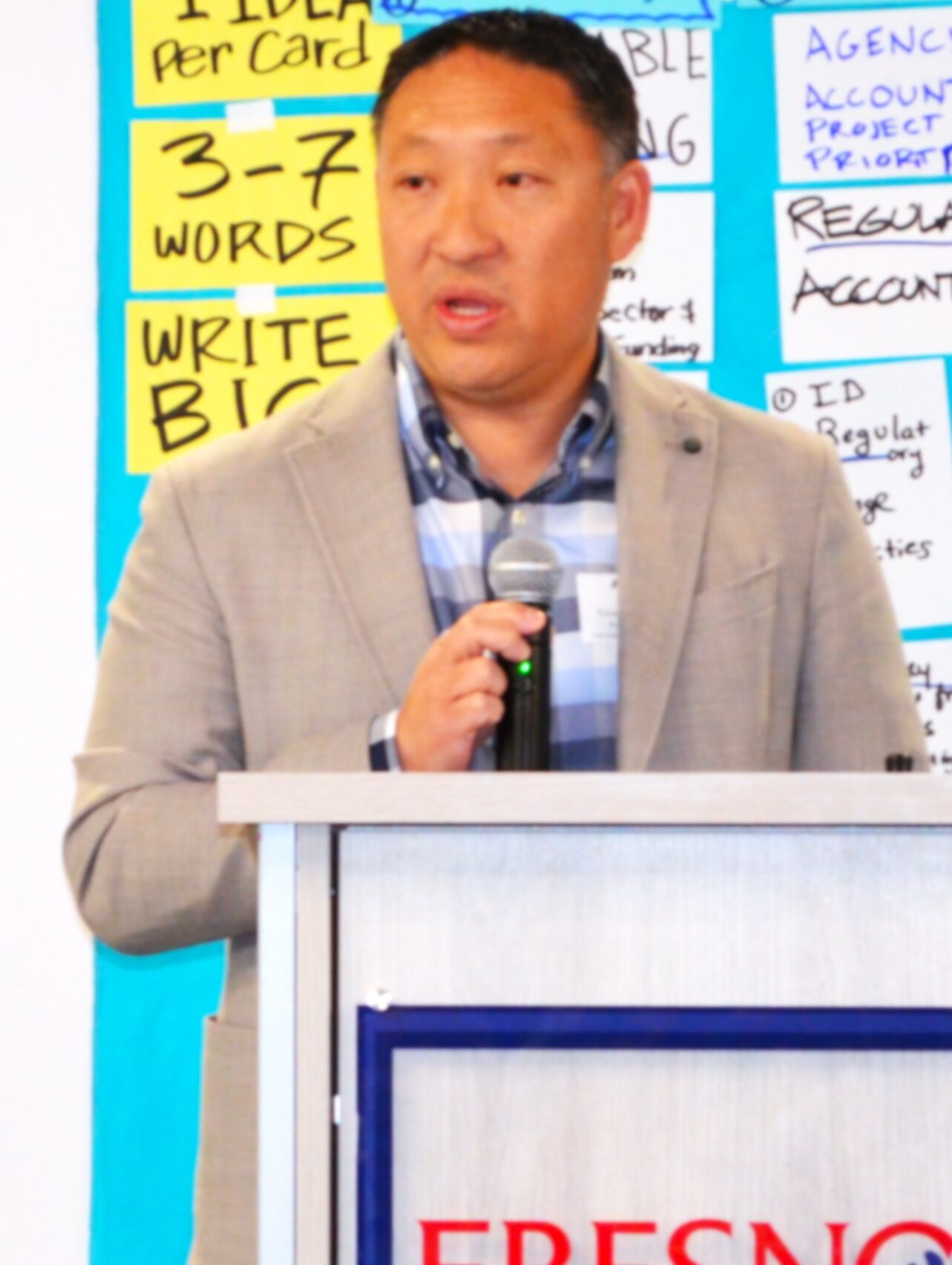
To provide a conclusion, Aaron Fukuda General Manager of the Tulare Irrigation District offered closing remarks. He said he was encouraged that the meeting “was not just a therapy session.” He said, “We’re all at the table together.”
He said it’s clear, things will have to be done differently, with collaboration of interest groups outside their own “silos.” He said it’s time to demand help and not just ask. He advocated for watershed scale pilot projects for proof of concept for solutions.
Wrapping up, Ms. Ramos said that CWI will synthesize the findings of the group, draft a follow-up letter and prepare a summary report. She thanked the sponsors and the attendees once more and brought the session to a close at the scheduled 3 p.m.
DISCLAIMER OF RESPONSIBILITY; Waterwrights.net strives to provide its clients with the most complete, up-to-date, and accurate information available. Nevertheless, Waterwrights.net does not serve as a guarantor of the accuracy or completeness of the information provided, and specifically disclaims any and all responsibility for information that is not accurate, up-to-date, or complete. Waterwrights.net’s clients therefore rely on the accuracy, completeness and timeliness of information from Waterwrights.net entirely at their own risk. The opinions expressed in this report are those of the author and do not represent any advertisers or third parties.
ALL RIGHTS RESERVED. Copyright 2026 by WaterWrights.net