


 By Joel Hastings – all photos by J. Hastings, WaterWrights.net
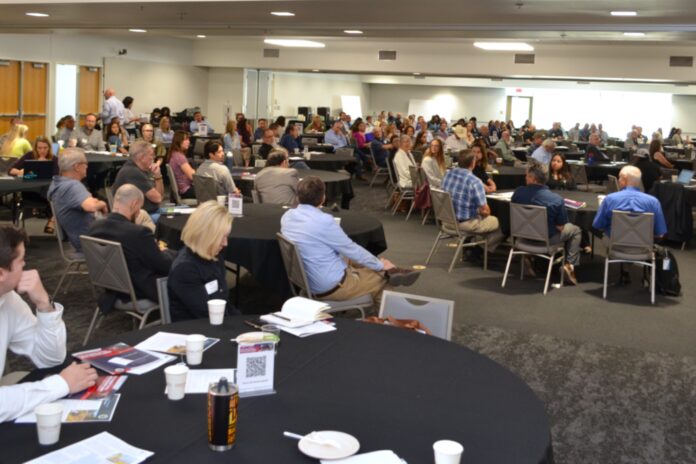
The California Water Institute at Fresno State organized and conducted a conference aimed at not only providing new information but also setting priorities for action to address the water crisis in the San Joaquin Valley. Over 150 people attended all or parts of the two-day session on May 20-21 on campus representing an array of water industry participants including growers, community leaders, water managers, academics and government officials.
The group heard reports of new studies from the Department of Water Resources (DWR), an update on the recently completed “Unified Water Plan for the San Joaquin Valley” from the Water Blueprint and the State’s Water Plan for 2028. Panel discussions provided additional background on this detail during the first day. Then on the second day, the whole group engaged in an in-depth effort to identify actions needed to accomplish specific priorities for results.
The mission, and the need, is to create nine million acre-feet of additional water for the Valley by 2040. This is now DWR’s priority as it implements the legislature’s SB 72 passed unanimously last year.
The Opening Session
To begin the first morning’s session, Laura Ramos, conference organizer and director of the California Water institute, welcomed the group and introduced Fresno State’s president, Dr. Saul Jimenez-Sandoval. He too welcomed the audience the opening morning. He said there are more challenges today than when he was growing up on a tomato farm. The Central Valley, he said, produces 25 percent of the nation’s food supply so what happens here impacts not just California but the entire nation and beyond. He said it was his hope that the meeting would produce concrete results to advocate for support from the state and federal governments.
Ramos then introduced Congressman Jim Costa who appeared on Zoom, thanking him for his support of the CWI and Fresno State. He said it’s a crucial time for not only water for farms but for sustenance for all of us. He praised the Institute and then cited federal legislation he’s been part of to provide funds for additional water storage in the Central Valley, with the Sisk Dam, the Sites Dam and restoring capacity for the Friant Kern Canal. He said he has supported improved operations by the Army Corps and the Bureau for managing water levels behind the state’s dams in light of less snow and more rain. He also spoke of recharge projects and new water purification efforts. He thanked the audience for their work to come, saying it was important not only for California but for the country as a whole.
Ramos set the stage for the meeting saying the Summit was designed to move from reports to results and from results to action. She said today we’re required to think differently about water… in terms of interrelated systems.
She said, “You cannot save groundwater without thinking about surface water. We can’t think of flood management without thinking about recharge. We can’t think about conveyance without thinking about subsidence, land use and long-term investment. And we cannot think about long-term resilience without considering communities, agriculture, ecosystems and economic stability.”
She continued saying today we have new information, especially reports from DWR on climate risk, FloodMar, a unified water plan, all individually good but requiring that we work together. She said that by the end of the day we will be discussing a broad plan for groundwater and surface water. Tomorrow will be about policy and regulations connecting academia and water users.
She said, “We need a path forward that is focused, actionable and sustained.”
She explained that graphic artist and recorder Leslie Salmon-Zhu would be capturing the key words and images from the program on large displays throughout the day which were to be used as the basis for discussion on day two.
She concluded her remarks, “Let’s begin with openness, honesty and a shared commitment to the San Joaquin Valley.”

Three DWR Studies
DWR planning staff presented overviews of three studies recently completed on various aspects of challenges facing Valley water systems. Andrew Schwarz led off with a strategy that might allow the State Water Project to adapt to a changing climate that likely will be hotter and dryer. He said in the next 20 years California could lose as much as ten percent of overall water supplies and if it’s hotter and dryer, as much as 25 percent. In moving water from the wetter north to the dryer south, the SWP is pursing three categories of solutions. One is structural or “building stuff”. The second is operational, changing the way the system is managed. And the third involves natural systems such as reservoir and even forest management. He said what’s needed is not a silver bullet or single solution but rather “silver buckshot” to deal with these issues. He outlined scenarios that included doing nothing, or maintaining and repairing the existing infrastructure or taking all possible actions which could add flexibility, security and reliability across the street.
Secondly, Eric Tsai reported on the San Joaquin Valley Conveyance Study. He said that in recent decades, both drought and regulations have constrained surface water deliveries. The canal and the aqueduct have seen reduces supplies by 46 percent. He said subsidence has reduced Friant Kern Canal flows by 66 percent and if no action is taken. The Delta Mendota Canal flows could be reduced by 86 percent with Friant Kern flows reduced by 186,000 acre-feet if nothing is done about subsidence. He said that subsidence also reduced the use of wet year flows for recharge, resulting in even more subsidence. With that in mind, the DWR priority is to reverse subsidence as quickly as possible.
He said a second part of the study was to evaluate conveyance needs, considering water availability, capacity and demand in a 25-year time frame. He said the primary need is more surface water supplies which must be developed before there is new investment in conveyance.
A third study summary was presented by David Arrate, looking at Flood-Mar (managed aquifer recharge) watershed on the east side of the Valley. Briefly, using FIRO – forecast informed reservoir operations – which involves releasing water further in advance of forecast storms, more water is captured and available for recharge and the likelihood of flooding along the Tuolumne, Merced and San Joaquin rivers and tributaries is reduced. He said these strategies are possible when water rights holders and landowners, reservoir and water systems managers and those protecting the ecosystem can work together. His study included detailed estimates of the volumes of water that might be available under different climatic conditions.
Following the presentations, the three staff answered questions from the audience with more discussion, during which it was stated that additional research might be conducted along the Kings River and further south.
WHAT THESE INSIGHTS MEAN
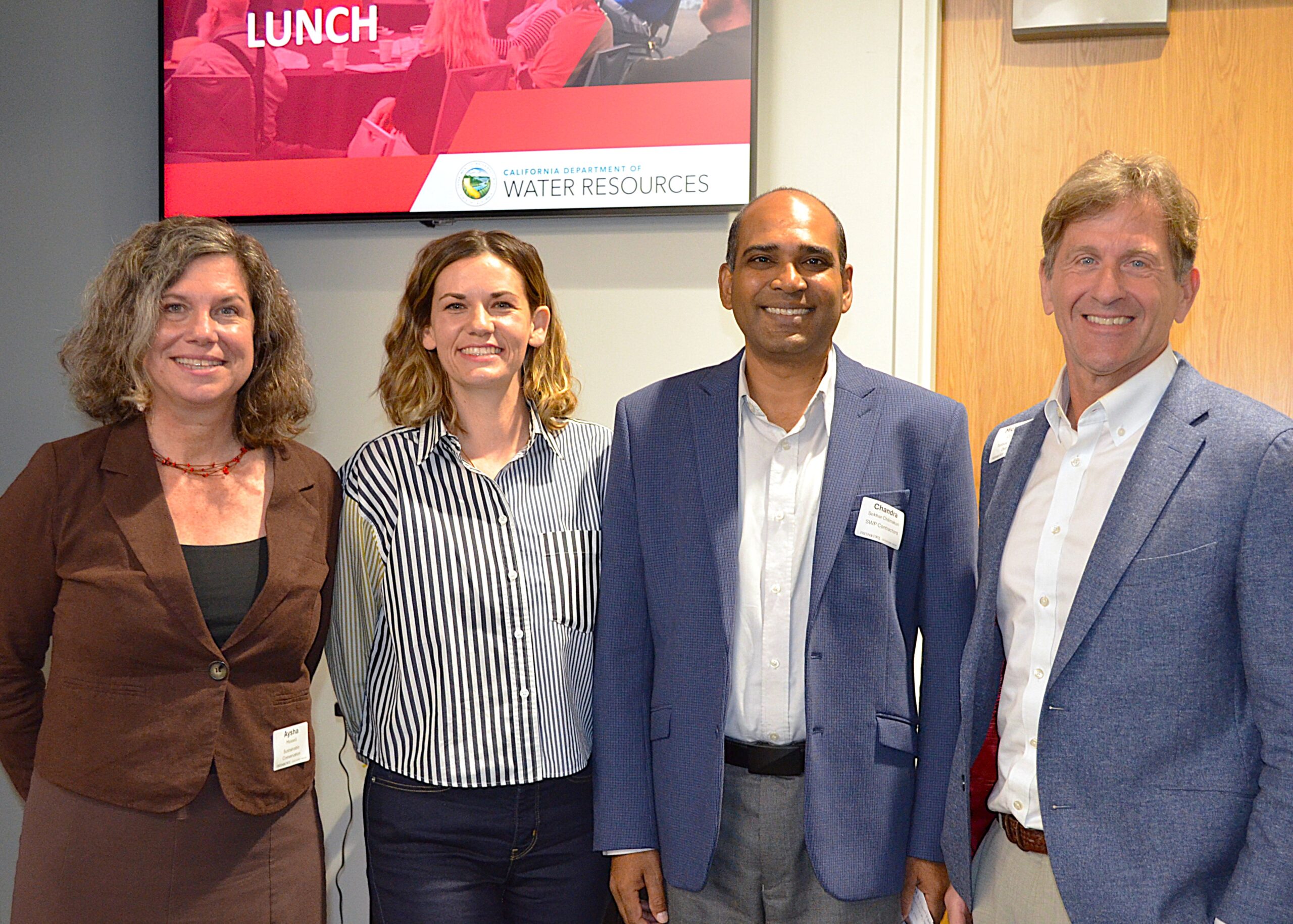
A panel discussion was next entitled in part, “… what these insights mean.” Participating were Michael Cooke of the Turlock Irrigation District; Aysha Massell of Sustainable Conservation; Chandra Sekhar Chilmakuri representing the State Water Project Contractors; and Taylor Broadhead of Audubon California; and moderator Tim Godwin, adviser to Paul Gosselin, who heads up the SGMA staff at DWR.
Chilmakuri said there is a difference between planning and getting the regulatory changes needed. He said we’re seeing great studies and the impact of climate changes but at the same time the State Board is asking for more flows to be in the river. He said these inconsistencies at the state agency level create uncertainties. With disparate and sometimes conflicting interests represented here, the group looked for areas of common ground even with different priorities. Massell suggested those suffering negative impacts should be heard and not just steamrolled.
When questions from the audience were invited, former Congressman John Duarte led off saying he had heard nothing about what he termed the human health catastrophes being visited on the Valley by farmland going out of production due to lack of water. He said some environmental concerns are “anti-human” and he said human health should be given much more consideration.

Unified Water Plan
Following the lunch break, the Unified Water Plan for the San Joaquin Valley was summarized by Bill Swanson of his consulting firm, Stantec. Developed by the broad-based volunteer group Water Blueprint, it includes recommendations for three segments – local and regional agencies; state and federal agencies; and for the Calif. Water Institute and the Blueprint organization itself. Swanson provided background about how this process had evolved including input from all sectors.
Locally, continued implementation of GSA projects is encouraged while supporting regional, state and federal partnerships and projects. At the state and federal level, the report recommends restoring the capacity of canals affected by subsidence, implementing new, non-traditional funding mechanisms. Implementing adaptive reservoir management and streamlining the permitting process to allow timely implementation of water supply projects. Support for updated regulations to effectively protect eco-systems while allowing increased water flows to SWP and CVP should be provided.
He concluded saying next steps for the Blueprint and CWI are providing support for evaluation and selection of projects, coordinating regional partnerships and advocacy and providing routine updates on the implementation of the Plan.

Putting the Plan Into Practice
Following Swanson, a panel discussion digging into the elements of the plan was moderated by Ms. Ramos. On stage were Joel Metzger, DWR Deputy Director of Statewide Resource Planning; Levi Johnson, Bureau of Reclamation Central Valley Operations Director; and Geoff Vanden Heuvel, vice-chair of the Blueprint and director of economic and regulator affairs on the California Milk Producers Council.
During the discussion, Metzger said that the legislature’s and governor’s support for SB 72 directing the DWR to prepare a singled detailed and realistic assessment and plan for California’s water provided clear direction. Johnson similarly said have a plan providing unified priorities would allow the federal agencies involved including the Corps and EPA (Environmental Protection Agency) to better coordinate. Vanden Heuvel advocated for a new approach to state funding instead of the traditional “user pays” approach. He said safe drinking water should not be funded by “cap and trade” energy policy and instead, California should consider an approach like Texas – a significant fund for water in the annual budget year after year.
DWR Director – California Ag, the Truly Transformative Industry
Longtime state government official Karla Nemeth is director of the Department of Water Resources. She opened her comments calling agriculture California’s truly transformational industry even though Silicon Valley gets more notoriety. She acknowledged her topic, the realm of the possible for surface water and groundwater. She said she agreed with Mr. Duarte’s comment that water issues represent a human crisis, as well. She said that to be candid about what holds us back is the regulatory environment. She said on April 1 (the official date to measure Sierra snowpack) we realized that snow levels had topped out on February 24. After study, the Turlock and Merced water boards asked what to do with the 450,000 acre-feet of water that were required to be released. She said a big barrier to sorting out the timing of releases is that leaving it to state agencies, which is way too slow.
She said, “We have to start putting this together as a whole plan for the Valley… and we need to solve problems among folks who have conflicts.”
She continued saying she agreed that farmers should not have to pay for all the infrastructure changes. There are many other beneficiaries of the new groundwater basins. She said she also agreed with the comments from Vanden Heuvel who has told her of the problems created when flood water, groundwater and surface water all come together. She credited Senator Anna Caballero (D-Merced) for SB 72, requiring a plan for California. She said we need a state team to act promptly for permitting projects. She concluded saying, “Water is synonymous with the economy and the environment… now is the time to think big.”

Realm of the Possible
Nemeth then joined a panel also moderated by Ms. Ramos that was composed of Eddie Ocampo, chair of the Water Blueprint and director of public affairs for Self-Help Enterprises; Sara Woolf, SJV Water Collaborative Action Program; Caitlin Peterson of the Public Policy Institute’s Water Policy Center; and Tekoah Kodara of the Allensworth Progressive Association. This group covered a good bit of ground, including the need to keep moving forward while acknowledging what has been accomplished. It is important to consider the impact of water on the whole community. Another factor is a lack of trust among the various interest groups including agriculture, government, environmentalists, ag water supply providers and drinking water advocates. Nemeth said a message needs to be prepared to send to the new governor who will find that water is a scary issue, local, complex and controversial. The governor should not be asked to say what he/she will do but instead, should be told what is needed.
Ramos concluded the afternoon program saying water must be considered with all the factors in mind since all the community is involved. She said the next five years are really, really important.
This ends part one of this two part series.
DISCLAIMER OF RESPONSIBILITY; Waterwrights.net strives to provide its clients with the most complete, up-to-date, and accurate information available. Nevertheless, Waterwrights.net does not serve as a guarantor of the accuracy or completeness of the information provided, and specifically disclaims any and all responsibility for information that is not accurate, up-to-date, or complete. Waterwrights.net’s clients therefore rely on the accuracy, completeness and timeliness of information from Waterwrights.net entirely at their own risk. The opinions expressed in this report are those of the author and do not represent any advertisers or third parties.
ALL RIGHTS RESERVED. Copyright 2026 by WaterWrights.net