



 By Don A. Wright
The Friant Water Authority board of directors met at the FWA headquarters in Lindsay on Thursday, January 22, 2026. Lindsay is known for its murals and maybe you might remember Al Radka. He sold Lindsay Olives on local Fresno Television. I thought of that as I crunched olives under my boots walking up to the headquarters from parking. I didn’t notice any purple stains on the FWA floors so, good for them.
The Meeting
The meeting began at 10:23am with Chairman Rick Borges announcing in closed session the board appointed Johnny Amaral as the new Chief Executive Officer and it takes place immediately. Amaral was CEO as soon as the meeting started. Congratulations. Director Cliff Loeffler led us in prayer asking for wisdom and unity and thanking the Lord for the Friant staff.
Action Items
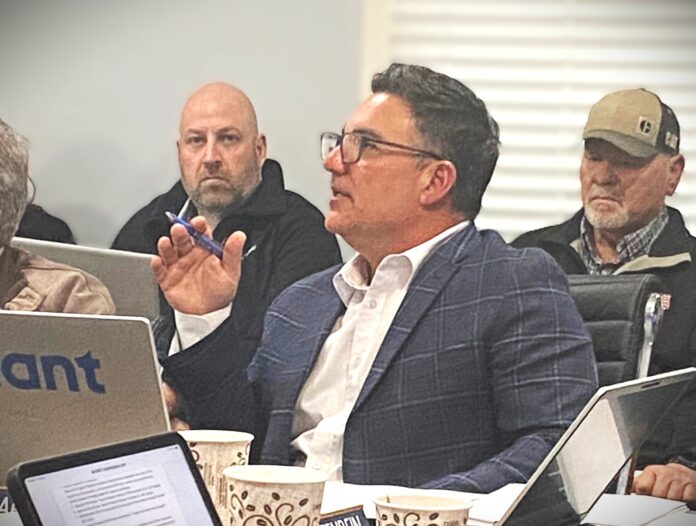
Ian Buck-Macleod told the board Friant has been working with San Joaquin River Restoration entities, including the US Bureau of Reclamation. FWA sent out an RFP for consultants to help with keeping abreast of the situation by conducting special studies. Stantec was the only qualified proposal. Buck-Macleod said they bring an excellent team but it’s large and expensive – $1.3 million. Buck-Macleod recommended capping the agreement at $1 million pending a clear cost sharing agreement with the Bureau. Director Carl Janzen asked if Stantec was the only respondent. Other firms asked about the RFP but only Stantec responded. The board agreed to the recommendation.
Venue Change
Amaral said the item about relocating the FWA Board meetings was going to be voted on today but the package wasn’t completed. The HQ just isn’t big enough. It was packed and awkward. The staff had to shuffle Lisa McEwen of SJV Water and myself around to get a seat near a power outlet. It’s one of the few times as a reporter I’ve been shown this much curtesy. Ag water is a good beat.
SLDM
Wilson Orvis reported the biggest development at San Luis Delta Mendota Water Authority was the budget passing. Friant pays a substantial amount of SLDM’s budget because of the exchanging of San Joaquin River water for Delta water.
Water Ops
Buck-Macleod said the precipitation levels are high but the snowpack is low due to warmer temperatures. The Northern Sierra snowpack is at 50 percent while the Central and South Sierra is running at normal. There may be more storms about the first of February and we need more snow.
On the brighter side Trinity, Shasta, Folsom and Oroville Reservoirs have all had enough inflow to make flood releases but they are ramping down now. As time moves on things may change if we don’t get more rain but Shasta looks like a 50 percent allocation at this point.
Christmas week triggered the entrainment regulations at the Delta pumps. That causes some shuffle in the Old and Middle SJR flows. So far no smelt has been seen near the pumps. They are keeping a close watch on the salmon side but unless hydrology plumets there should be decent pumping. Buck-Macleod said turns out the smelt don’t hang out near the pumps during this time of year. They stay more to the north and west portions of the Delta at this time of year.
Buck-Macleod said San Luis Reservoir is above a 90 percent forecast. By March there will be 750,000 a/f in SLR with more than 450,000 a/f of that federal Central Valley Project supplies. This means it’s not likely the Bureau will make a call on Friant supplies to meet its Exchange Contractor obligations. Buck-Macleod doesn’t see any upcoming spill at SLR. He said the State Water Project storage at SLR should fill this year as well.
Buck-Macleod said on New Year’s Eve Class II Friant allocations went to 10 percent to help with moving flood space and not losing water. In couple of weeks Friant will be wrestling with the Army Corps of Engineers about releases and the danger of a spill at Millerton Lake. He said with the Friant Kern Canal repairs moving water is much more flexible.
The Airborne Snow Observatory will soon begin flights and that will be very helpful when determining how much snowmelt will come rolling down the hill. The current weather conditions are ideal for this.
Golden Mussels
Golden mussels have been discovered in the furthest downstream portion of the FKC. They’ve been treating the mollusks with hot water. A control plan has to be developed and it starts by checking for golden mussel DNA. The DNA has been detected as far upstream as the White River in Tulare County. Quagga and Zebra mussels boat inspections are checked at Millerton Lake but not golden mussels. Buck-Macleod wants testing at all the reservoirs along the canal. He said desiccation is the surest way to kill the little boogers but that’s difficult to do while trying to convey water. He said copper based chemical treatment is being looked at. He also expects that permitting could be difficult.
Attorney Julie Gantenbine said the meetings with regulators are going fairly well. It’s hoped the Bureau will conduct boat inspections at Millerton Lake. This wasn’t expected to be such a big deal but it is and it is impacting the operations and maintenance budget. Using ultraviolet radiation is also a promising treatment but energy expensive.
There was a discussion about how the inspections will be paid for and how that will impact the recreational component of Millerton Lake. Also, the quagga and zebra mussels need calcium and the San Joaquin and Kings Rivers are low in that mineral. The golden mussel doesn’t need much calcium.
Director Kent Stephens asked if Friant gets the proper permitting will that cover the districts and growers. Buck-Macleod said for members to check with their own district’s attorney. The little critter only grows an inch or so and there’s not much meat, so don’t boil your linguini.
Annie Holt was introduced as FWA’s new hydrologist. She has a background in flood modeling and water forecasting.
External Affairs
Next Mike Villines reported on state government matters and the Governor’s budget is a little rosier than other sources but it’s still at least an $18 billion deficit. There is a late February deadline for submitting bills and he expects more than 2,000 bills introduced this year, with maybe 20 to 30 of those being of direct concern or reasons for happiness to the water community.
Villines thanked Amaral and DWR Chief Karla Nemeth for their help and hard work for getting money from Prop One. There was another $5 million from the state’s general fund for increased hatchery personnel. This source of funding more is vulnerable to Indian giving.
Amaral gave the federal side saying some needed funding for the Friant Division of the CVP is under review but which way the wind blows is yet to be seen. After a long government shutdown last year it is possible for another shutdown at the end of the month. About 10 percent of the Congress will turnover each election cycle. Amaral recommended not getting worked up before the primaries. Austin Ewell reported members of Congress still get paid during a shutdown or take their backpay.
The Mid Pacific Water Users Conference is in Reno next week. The National Marine Fisheries leadership, the assistance administrator, will be touring the fish hatchery just downstream from Friant Dam. The annual Friant Dinner will be in May in Bakersfield. The California Water Institute is putting together a map of recharge areas and the data will be protected.
Director Edwin Camp asked is there is any movement to appoint a USBR Commissioner and Ewell said nothing at this time.
O&M
Chris Hickernell reported all staff is being safety tested and trained on everything from chainsaws to backhoes. He said the weed spraying has been going well. There was some washout along the FKC in Bakersfield and that was fixed. An access road was also washed out and repaired. Bridge maintenance is finished. Trash, homelessness encampments and vandalism including graffiti remains an ongoing challenge.
San Joaquin Valley Blueprint
Ewell reported there are four spending bills being voted on today and a shutdown may be avoided. He spoke about the Blueprint’s Unified Water Plan’s chapter five, a gathering of projects from Groundwater Sustainability Plans, is now under a comment period. Chapter Six is the last bit and the UWP will be available. SB72 will tie in with these efforts. Ewell thanked everyone for the help. Also, there is a support letter for Action Five about to be sent out.
CEO/COO
Amaral began by expressing his thanks and the confidence placed in him. He said he’s loved every minute at Friant and respects the staff immensely. He promised to do a great job and I believe he will. The meeting adjourned at 11:44am. And we dined on BBQ ribs and chicken. Go be good to yourselves and each other.
DISCLAIMER OF RESPONSIBILITY; Waterwrights strives to provide it’s clients with the most complete, up-to-date, and accurate information available. Nevertheless, Waterwrights does not serve as a guarantor of the accuracy or completeness of the information provided, and specifically disclaims any and all responsibility for information that is not accurate, up-to-date, or complete. Waterwrights’ clients therefore rely on the accuracy, completeness and timeliness of information from Waterwrights entirely at their own risk. The opinions expressed in this report are those of the author and do not represent any advertisers or third parties.
ALL RIGHTS RESERVED. Copyright 2026 by WaterWrights and DAW
FRIANT WATER AUTHORITY
854 N. Harvard Ave., Lindsay, CA 93247, Office 559/562-6305 Email:information@friantwater.org www.friantwater.org
The Friant Water Authority is a Joint Powers Agreement with 15 districts to operate and maintain the Friant Division of the Central Valley Water Project. Water from the San Joaquin River is diverted at Friant Dam at Millerton Lake to the Madera/Chowchilla Canal to the north and the Friant/Kern Canal to the south. More than one million acres of mostly family farms and numerous communities get their surface supplies from the Friant Division.
Board: Chair Rick Borges
Staff: CEO Johnny Amaral, CFO Wilson Orvis, Water Resources Manager Ian Buck-Macleod, Engineer Katie Duncan, Superintendent Chris Hickernell & Attorney Julie Gantenbine